
Why These Differences Matter in Substation Engineering

By Brian Varn, PE, Director, Substation
Clear documentation is the foundation of consistent, high-quality substation design. While engineering standards often receive the most attention, they are only one part of an effective documentation strategy. Understanding the difference between standards, processes, guidelines, and how-to documents helps utility companies and engineering teams enable effective communication, reduce errors, accelerate onboarding, and deliver consistent project outcomes.
As utilities modernize infrastructure, integrate new technologies, and manage increasingly complex projects, documentation becomes a strategic necessity.
Why Documentation Matters in Substation Engineering
Substation engineering depends on collaboration with civil, structural, electrical, protection and controls, SCADA, and project management teams, all contributing throughout a project's lifecycle. Clear documentation provides a common framework that helps everyone understand expectations, responsibilities, and project requirements.
At Westwood, we view documentation as more than recordkeeping.
Effective documentation reinforces our responsibility to help utilities deliver safe, reliable infrastructure to the communities they serve.
Common Documentation Challenges Utilities Face
Many organizations recognize the importance of documentation, but still encounter recurring issues that affect efficiency and consistency.
Common challenges include:
- Using standards, processes, and guidelines interchangeably.
- Depending on undocumented institutional or "tribal" knowledge.
- Lacking a clear process to review and update documentation as practices evolve.
- Failing to clearly distinguish between required standards, recommended guidance, and task-specific instructions.
- Spending time answering recurring questions because documentation is difficult to locate.
These issues often lead to inconsistent deliverables, slower onboarding, unnecessary rework, and increased dependence on individual subject matter experts.
What Is the Difference Between Standards, Processes, Guidelines, and How-To Documents?
Each document type serves a distinct purpose. Understanding these differences helps organizations build documentation systems that support both quality and efficiency.
Standards: Defining Mandatory Requirements
Standards establish the baseline expectations that engineering teams must follow.
They provide consistent expectations for safety, quality, and technical performance and are commonly developed by organizations such as IEEE, NESC, and IEC before being adopted or expanded upon by individual utilities.
Standards answer one primary question: What is required?
Because standards establish mandatory requirements, they generally use definitive language such as "shall" or “must”.
For example, a utility may have standard(s) to define the minimum protection settings requirements for their system, which must be followed.
Processes: Defining How Work Flows
While standards define requirements, processes define how work moves through an organization.
Processes identify the sequence of activities, project milestones, reviews, approvals, and responsibilities required to complete work successfully.
A process answers questions such as:
- Who performs each task?
- What reviews occur before a deliverable is issued?
- When does work move to the next phase?
Processes typically answer the question: How does the work flow?
Guidelines: Supporting Engineering Judgment
Engineering projects rarely fit into pre-defined scenarios. That's where guidelines provide value.
Guidelines recommend best practices while allowing engineers to exercise professional judgment when project conditions vary.
Rather than establishing mandatory requirements, guidelines provide decision-making support.
For example, a guideline might recommend selecting specific equipment when fault current exceeds a certain threshold while still allowing engineers to evaluate project-specific conditions.
Guidelines typically answer the question: What is the recommended approach?
How-To Documents: Executing Specific Tasks
How-to documents provide detailed instructions for completing individual tasks.
These resources are particularly valuable for:
- Software workflows
- Internal procedures
- Training new employees
- Frequently repeated activities
Unlike standards or processes, how-to documents often require regular updates as software, tools, and client requirements evolve.
How-To Documents typically answer the question: How do I complete this task?
How These Documents Work Together
Organizations achieve the greatest consistency when each document serves its intended purpose.
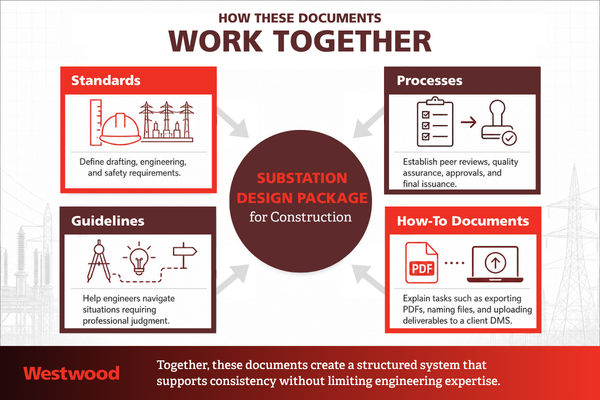
For example, issuing a substation design package for construction may involve:
- Standards that define drafting, engineering, and safety requirements.
- Processes that establish peer reviews, quality assurance, approvals, and final issuance.
- Guidelines that help engineers navigate situations requiring professional judgment.
- How-to documents that explain tasks such as exporting PDFs, naming files, or uploading deliverables to a client's document management system.
Together, these documents create a structured system that supports consistency without limiting engineering expertise.
Building a Documentation Strategy That Scales
As organizations grow, documentation becomes increasingly important for maintaining consistency across multiple offices, disciplines, and project teams.
An effective documentation system should:
- Clearly distinguish required practices from recommended practices.
- Be easy for employees to locate and reference.
- Reduce reliance on institutional knowledge.
- Be reviewed and updated as standards, tools, and workflows evolve.
- Encourage continuous improvement through employee feedback.
When documentation is structured intentionally, it becomes a resource that supports both experienced engineers and those entering the profession as the firm grows.
Measuring Documentation Success
Strong documentation systems create measurable improvements throughout an organization.
Signs of success often include:
- More consistent project deliverables.
- Faster onboarding of new employees.
- Fewer repeated procedural questions.
- Greater confidence in engineering decisions.
- Teams that routinely reference documentation instead of relying solely on individual expertise.
- Employees who actively contribute ideas to improve documentation over time.
These outcomes help organizations improve efficiency while maintaining quality and consistency across projects.
Better Documentation Supports Better Engineering
As utilities continue to invest in grid modernization, resilience, and the expansion of power infrastructure, effective documentation will remain essential to successful project delivery.
Standards, processes, guidelines, and how-to documents each serve a unique purpose. When used together, they create a framework that supports engineering judgment, strengthens quality assurance, improves collaboration, and helps teams deliver reliable results throughout the project lifecycle.
At Westwood, we believe strong documentation is ultimately about supporting people. When engineers have clear expectations, reliable resources, and well-defined workflows, they can spend less time searching for answers and more time delivering solutions that help our clients succeed.
Whether you're developing new documentation, refining existing processes, or looking to improve consistency across your substation engineering program, our team is here to help. Contact us to learn how our power professionals can support your organization with practical, experience-driven solutions that strengthen project delivery and position your team for long-term success.
...
About the Author
Brian Varn, PE, Director, Substation, is a seasoned electrical engineer with over two decades of industry experience and licensing in over 20 states. He oversees the design of electrical substations for utilities, ensuring they meet the highest safety and efficiency standards. Brian is known for his strategic approach to problem-solving, his commitment to innovation, and his dedication to mentoring the next generation of engineers.


